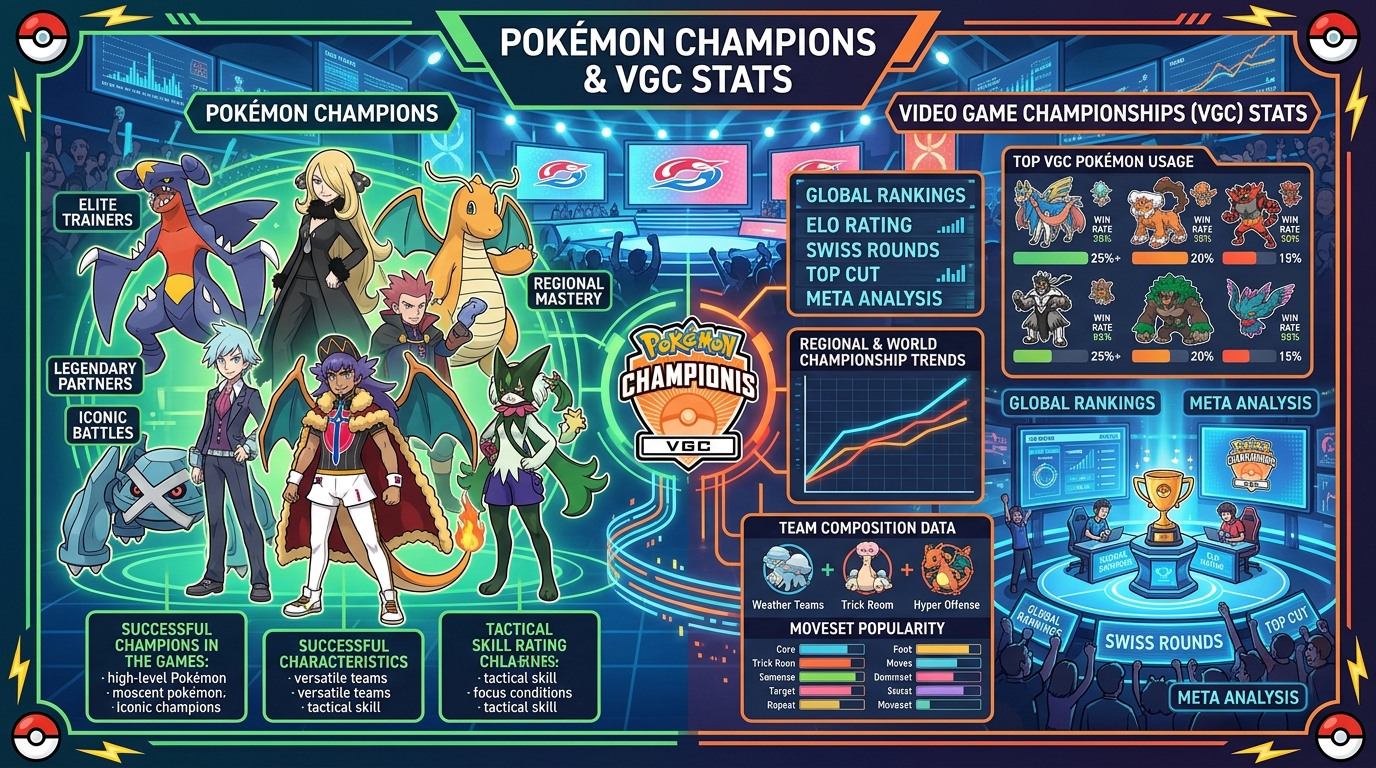
Pokémon Champions & VGC Stats: When I first started looking at Pokémon Champions and VGC stats, I honestly felt overwhelmed. There were so many team combinations, tier rankings, usage percentages, and strategy discussions that it became difficult to understand what actually mattered.
At first, I thought tier lists were only about choosing the strongest Pokémon, but after spending more time in competitive battles, I realized that the metagame is much deeper than simple rankings.
As I explored more competitive matches, I noticed that statistics play a huge role in understanding the current battle environment. The Pokémon that appear most often in top-ranked teams usually shape the entire meta. This affects how I build my own teams because I need to prepare for the most common threats if I want to win consistently.
I also realized that VGC style gameplay is very different from casual Pokémon battles. Team synergy, speed control, positioning, and prediction become much more important than raw power alone. This means I need to understand not just individual Pokémon, but how entire team strategies work together.
In this guide, I will explain how Pokémon Champions metagame stats and tier lists work, why they matter, and how I can use them to improve my competitive gameplay.
Pokémon Champions & VGC Stats Overview Table
| Metagame | Current competitive trends |
| Tier Lists | Rank Pokémon strength |
| Usage Stats | Popular Pokémon data |
| Team Synergy | Better coordination |
| Matchups | Counter strategies |
| VGC Style | Competitive doubles focus |
| Strategy | Improve consistency |
| Goal | Build stronger teams |
What Is the Pokémon Champions Metagame
When I first heard the word “metagame,” I thought it sounded more complicated than it actually is. After playing more ranked battles, I understood that the metagame simply refers to the most effective strategies, Pokémon, and team styles currently being used by competitive players. These trends change over time depending on updates, balance changes, and player discoveries.
I also noticed that the metagame affects almost every battle I play. If certain Pokémon become very popular, I need to prepare counters for them or risk losing repeatedly against similar teams. This means understanding the meta is not optional if I want to stay competitive.
Another important thing I realized is that the metagame constantly evolves. A strategy that works today may become weaker later as players discover new counters and team combinations. This keeps the game fresh and prevents the competitive scene from becoming completely predictable.
For me, understanding the metagame is like understanding the current environment of competitive battles. It helps me prepare smarter teams and make better decisions during matches.
Read Also: How to Play Pokémon Champions on PC (Safe & Official Guide)
How Tier Lists Work
When I first looked at tier lists, I assumed they were official rankings made by developers. Later, I realized that most tier lists are created by competitive communities based on performance, usage, and overall effectiveness in battles. These rankings help players understand which Pokémon currently perform well in the meta.
I also noticed that tier lists are not only about raw strength. Some Pokémon rank highly because they fit easily into many teams, while others succeed because they counter popular strategies effectively. This means a lower-tier Pokémon can still perform very well in the right situation.
Another important thing I understood is that tier lists should guide me, not control my decisions completely. If I blindly follow rankings without understanding team synergy, I may still struggle in battles. Strategy matters more than simply picking highly ranked Pokémon.
For me, tier lists are useful tools for understanding the competitive environment, but they are most effective when combined with personal strategy and experience.
Why Usage Stats Matter
When I started studying usage stats, I realized that they reveal which Pokémon and strategies are most common among top players. This information is extremely useful because it helps me predict what I am likely to face during ranked battles.
I also noticed that usage percentages often highlight dominant Pokémon in the current meta. If a certain Pokémon appears in a large percentage of top teams, I need to prepare ways to handle it consistently. Ignoring popular threats usually leads to unnecessary losses.
Another important thing I understood is that usage stats can reveal hidden trends. Sometimes a Pokémon becomes stronger not because it changed directly, but because the overall meta shifted in its favor. Paying attention to statistics helps me notice these changes earlier.
For me, usage stats act like a roadmap for competitive preparation. They show me what strategies are currently successful and what threats I should expect most often.
Understanding VGC Style Battles
When I explored VGC gameplay, I realized that doubles battles require a completely different mindset compared to casual single battles. Positioning, support moves, and team coordination become much more important because two Pokémon are active on the field at the same time.
I also noticed that speed control is one of the biggest factors in VGC style matches. Managing turn order often decides the outcome of battles, which means I need to build teams carefully around timing and synergy.
Another important thing I learned is that defensive switching and support strategies are much stronger in doubles formats. Pokémon that may look average individually can become extremely powerful when paired with the right teammates.
For me, VGC gameplay feels more strategic and team-oriented because every move affects multiple Pokémon and changes the flow of battle much faster.
How to Use Meta Knowledge Effectively
When I started improving competitively, I realized that understanding the meta is only useful if I know how to apply that knowledge during team building and battles. Simply memorizing popular Pokémon does not automatically make me a better player.
I also noticed that successful players adapt instead of copying blindly. If everyone uses the same teams, I can gain an advantage by preparing strong counters or unexpected strategies that disrupt common patterns.
Another important thing I understood is that flexibility matters. The meta constantly changes, so I need to keep adjusting my teams instead of becoming stuck with outdated strategies that no longer work effectively.
For me, using meta knowledge properly means combining information with creativity. The strongest players are usually the ones who understand trends while still developing their own unique approach.
Common Mistakes Players Make
When I watched newer competitive players, I realized that many of them rely too heavily on tier lists without understanding why certain Pokémon are strong. This often leads to poorly coordinated teams that struggle despite using high-ranked Pokémon.
I also noticed that some players ignore team synergy completely. They focus only on individual strength, which creates weaknesses against balanced and coordinated strategies. Competitive gameplay rewards teamwork much more than isolated power.
Another common mistake is refusing to adapt. Some players continue using the same strategy even after the meta changes around them. This makes it difficult to stay competitive against evolving team styles and counter strategies.
For me, avoiding these mistakes is just as important as learning advanced techniques. Strong fundamentals and smart adaptation create more success than blindly following trends.
Conclusion
When I look at everything together, I understand that Pokémon Champions and VGC stats are not just numbers or rankings. They represent the constantly evolving competitive environment that shapes how players build teams and approach battles.
I also see that tier lists and usage statistics are helpful tools, but they work best when combined with strategy, adaptability, and personal experience. Simply copying top teams is not enough to succeed consistently.
The most important lesson for me is that the metagame never stays the same. Players who continue learning and adapting usually perform much better over time than players who rely only on old strategies.
For me, understanding the metagame and tier lists has made Pokémon Champions much more interesting because it adds depth, planning, and long-term strategy to every competitive battle.
