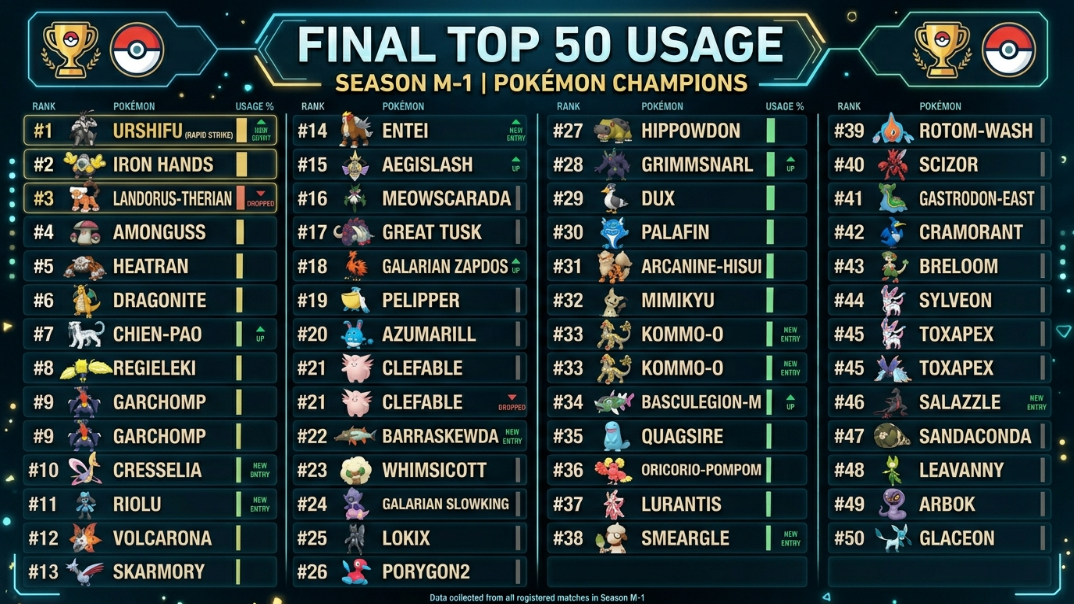
Final Top 50 Usage for Season M-1 of Pokémon Champions: When I first looked at the final usage stats for Season M-1 in Pokémon Champions, I realized just how important usage data is for understanding the competitive meta. A lot of players focus only on tier lists, but usage rankings actually show what people are truly using in real battles. This makes the stats extremely useful because they reflect the current competitive environment instead of just theory.
As I explored the rankings more carefully, I noticed that some Pokémon were expected to dominate while others surprised me completely. Certain Pokémon appeared in a huge percentage of teams because they offer flexibility, strong abilities, or powerful synergy with the current meta strategies. This clearly shows how the competitive scene has started stabilizing around specific team structures.
I also found the Mega Evolution usage comparison very interesting. Some Mega forms were used more often than their base versions, while others struggled to justify their slot. Seeing statistics like “50 percent of Gyarados players used Gyaradosite” helps me understand how valuable Mega Evolutions currently are in ranked battles.
In this article, I will explain what the Season M-1 usage rankings reveal about Pokémon Champions, why these stats matter, and what they tell me about the current competitive metagame.
Final Top 50 Usage for Season M-1 of Pokémon Champions Overview
| Season | M-1 |
| Data Type | Usage statistics |
| Focus | Competitive meta |
| Most Important Factor | Team consistency |
| Mega Evolution Usage | Compared with base forms |
| Meta Trend | Balanced but centralized |
| Competitive Format | Ranked battles |
| Purpose | Understand strongest strategies |
What Usage Stats Actually Mean
When I first started paying attention to usage statistics, I thought they simply represented the strongest Pokémon in the game. But after analyzing more competitive battles, I realized usage data actually reflects something deeper. It shows which Pokémon players trust the most in real ranked matches, especially at higher skill levels where consistency matters more than flashy strategies.
I also noticed that high usage does not always mean a Pokémon is unbeatable. Sometimes a Pokémon becomes popular because it fits easily into many different teams, while other Pokémon stay lower in usage despite being extremely dangerous in the right hands. This means usage rankings help me understand trends, but not absolute power.
Another important thing I realized is that usage stats reveal how centralized the meta has become. If the same Pokémon appear repeatedly across top teams, it usually means the competitive environment is becoming more focused around a smaller group of dominant strategies.
For me, usage statistics are one of the best ways to understand what is actually happening in the competitive scene instead of relying only on opinions or predictions.
Why Certain Pokémon Dominated Season M-1
When I looked through the rankings, I noticed that the most used Pokémon shared a few important characteristics. Most of them were flexible, reliable, and easy to fit into multiple team styles. This explains why they consistently appeared across both aggressive and balanced strategies.
I also realized that many top Pokémon provided strong utility beyond simple damage output. Speed control, defensive support, pivoting, and team synergy mattered just as much as raw offensive power. This shows how strategic Pokémon Champions has become at higher competitive levels.
Another thing I noticed was that some Pokémon became dominant simply because reliable counters were limited. Since the roster in Pokémon Champions is still smaller compared to traditional Pokémon games, certain threats naturally became harder to handle consistently.
For me, the Season M-1 rankings clearly show that versatility and consistency are currently more valuable than gimmicky or highly specialized strategies.
Mega Evolution Usage Trends
When I explored the Mega Evolution statistics, I found them especially interesting because they revealed how players value certain Mega forms compared to their regular versions. For example, seeing that around half of Gyarados players used Gyaradosite tells me that Mega Gyarados is considered valuable, but not always mandatory.
I also noticed that some Mega Evolutions were clearly preferred over their standard forms because they provided stronger stats, abilities, or better matchup potential within the current meta. Other Mega forms struggled because their advantages were not strong enough to justify the Mega slot.
Another important thing I realized is that Mega Evolution decisions often depend heavily on team structure. Some teams benefit more from the flexibility of the regular form, while others are built specifically around maximizing Mega Evolution pressure.
For me, the Mega usage data highlights how strategic resource management has become in Pokémon Champions competitive gameplay.
What the Meta Looks Like Right Now
When I studied the overall rankings, I realized that the current Pokémon Champions meta feels somewhat balanced, but also slightly centralized around a core group of highly reliable Pokémon. This means there is still variety, but certain Pokémon clearly dominate top-level play more often than others.
I also noticed that balanced teams appear to perform very consistently. Hyper-aggressive strategies still exist, but players who combine offense, defense, and utility seem to have the most long-term success across ranked battles.
Another important thing I understood is that the smaller roster size strongly affects the meta. Since there are fewer available Pokémon and items compared to older Pokémon games, players naturally gravitate toward the safest and most reliable options.
For me, the current meta feels competitive and strategic, but it also shows why many players are asking for roster expansions and additional balancing updates in future seasons.
Why Community Data Matters
When I started following community-created statistics and tier resources, I realized how important they are for improving competitively. Official games usually do not explain the meta in detail, so community analysis helps players understand trends much faster.
I also noticed that fan-made resources like usage charts and custom tier makers make competitive discussions easier. Instead of relying on random opinions, players can look at actual data and compare strategies more objectively.
Another thing I appreciated was the effort players put into organizing Mega Evolution comparisons alongside base forms. This kind of detail helps me understand not just which Pokémon are strong, but how players are actually using them during ranked play.
For me, community-driven data is one of the reasons competitive Pokémon remains so active and interesting over time.
What Could Change Next Season
When I think about future seasons, I honestly expect the meta to shift significantly once more Pokémon, items, and balance updates arrive. Right now, many strategies feel stable because the available roster is still somewhat limited.
I also noticed that even small balance changes can completely reshape usage rankings. A single new Pokémon or item can suddenly create counters to dominant strategies that currently feel almost unstoppable.
Another important thing I realized is that players themselves continue improving over time. As strategies become more refined, some Pokémon may rise or fall naturally even without major updates from developers.
For me, this is what makes competitive Pokémon exciting. The meta never truly stays the same, which means there is always something new to learn and adapt to.
Read Also: When Is Pokémon Champions Coming To Mobile?
Final Thoughts
When I look at the Season M-1 usage rankings overall, I understand that they provide a very clear snapshot of the current Pokémon Champions competitive environment. The data shows which Pokémon players trust most and which strategies consistently succeed in ranked battles.
I also see that Mega Evolution usage adds another interesting layer of strategy, especially when comparing Mega forms directly with their regular versions. This helps reveal how players value flexibility versus raw power.
The most important lesson for me is that usage stats are not just numbers. They represent real player behavior and real competitive trends happening across the ranked ladder.
For me, the Season M-1 rankings make Pokémon Champions feel much more alive because they show how the community is shaping and evolving the competitive meta in real time.
