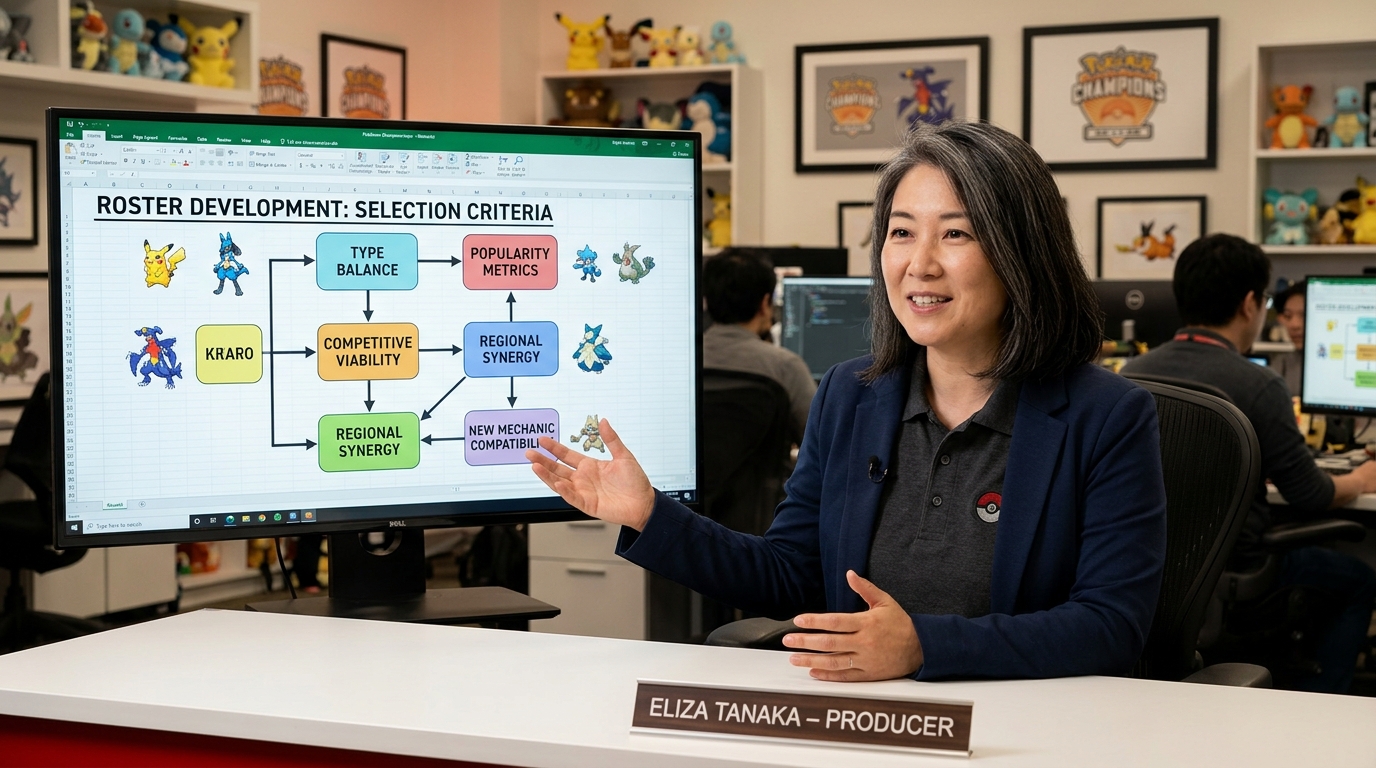
Pokémon Champions Producer Explains: When I first saw the limited Pokémon roster in Pokémon Champions, I honestly wondered why so many fan-favorite Pokémon were missing. A lot of players expected a much bigger selection at launch, especially since competitive Pokémon battles usually become more exciting with more variety. Because of that, many fans started asking how the development team is actually deciding which Pokémon get added to the game.
Recently, Pokémon Champions producer Masaaki Hoshino shared new details about this process in an interview with Nintendo Dream. After reading his comments, I realized that the team is approaching roster selection very carefully instead of simply adding every Pokémon immediately. The main goal right now seems to be making competitive battles easier for new players to understand.
I also noticed that the developers are focusing heavily on balance. Features like Mega Evolution, Terastallization, and advanced competitive mechanics can quickly make battles confusing if too many systems are introduced at once. Because of this, the team appears to be slowly building the competitive environment step by step.
In this article, I will explain what the Pokémon Champions producer revealed about the roster, future mechanics, Mega Evolutions, and how the game may continue evolving over time.
Pokémon Champions Producer Explains Overview Table
| Producer | Masaaki Hoshino |
| Current Roster | Around 200 Pokémon |
| Main Focus | Competitive balance |
| Beginner Friendly | Yes |
| Mega Evolutions | Priority feature |
| Future Additions | Planned gradually |
| Special Mechanics | Omni Ring system |
| Platform | Nintendo Switch |
Why Pokémon Champions Has a Limited Roster
When I looked at Hoshino’s comments, I realized that the smaller roster is not random. The development team intentionally started with a limited number of Pokémon because they wanted battles to feel easier to understand for newer competitive players. Instead of overwhelming players with hundreds of complicated options immediately, they are focusing on clarity and accessibility first.
I also noticed that the team is prioritizing Pokémon that clearly demonstrate strength and battle roles. This explains why many straightforward and recognizable competitive Pokémon were included early while some niche or highly specialized Pokémon were left out at launch.
Another important thing I understood is that the developers plan to expand the roster gradually over time. Hoshino mentioned that divisions and rule sets may eventually help organize larger groups of Pokémon as more creatures are introduced into the game.
For me, this approach makes more sense now because it shows the developers are trying to build a stable competitive environment before expanding the game too quickly.
How the Team Chooses Pokémon
When I read more about the selection process, I found it interesting that Game Freak veteran Shigeki Morimoto is personally involved in deciding which Pokémon are added. This tells me the team is treating roster balance as a very serious part of development rather than just adding random fan favorites.
I also noticed that the team is carefully considering how each Pokémon affects the competitive environment. Some Pokémon may look harmless casually but can become extremely dominant in competitive formats. This means every addition requires testing and balancing before release.
Another thing I realized is that the team wants the early game experience to remain easy to understand. Hoshino specifically mentioned that Pokémon like Clefairy and Porygon2 may appear later, but the initial focus is on simpler battle clarity for newer players.
For me, this shows that Pokémon Champions is being designed not only for experienced competitive players but also for people entering competitive Pokémon battles for the first time.
Read Also: Pokémon Champions PC: Can You Play It on PC? Full Guide
Mega Evolutions Are a Major Priority
When I saw Hoshino discuss Mega Evolutions, I immediately understood why so many players are excited. Mega Evolution remains one of the most popular mechanics in Pokémon history, and Pokémon Champions appears to be treating it as the first major advanced battle system.
I also noticed that the developers are being extremely careful about timing. Hoshino explained that introducing Mega Evolutions requires balancing consideration because these forms can dramatically affect competitive gameplay and team strategies.
Another important thing I learned is that Mega Evolutions seem to be the first special mechanic the developers want players to master before introducing more complicated systems like Terastallization. This gradual approach may help prevent the competitive scene from becoming too chaotic too quickly.
For me, focusing on Mega Evolutions first feels smart because they are popular, recognizable, and easier for many players to understand compared to newer battle mechanics.
The Omni Ring and Future Battle Mechanics
When I explored the interview further, I found the Omni Ring system especially interesting. According to Hoshino, this item is being designed to manage special battle mechanics like Mega Evolution and potentially future systems such as Terastallization.
I also realized that balancing multiple mechanics together is probably one of the hardest challenges for the development team. If too many powerful systems are active at once, battles could become confusing and difficult to balance competitively.
Another important thing I noticed is that the team does not seem interested in rushing these features. Instead, they want to introduce mechanics gradually while observing how players respond to each competitive environment.
For me, this careful pacing feels like a good long-term strategy because competitive games usually become healthier when new mechanics are introduced slowly and tested properly.
What This Means for the Future of Pokémon Champions
When I look at everything together, I feel like Pokémon Champions is being treated more like a long-term competitive platform rather than a traditional Pokémon release. The developers seem focused on building a stable foundation before expanding the roster and mechanics aggressively.
I also noticed that this slower rollout may frustrate some players right now, especially fans waiting for favorite Pokémon or advanced mechanics. However, it may help prevent major balance problems that could hurt the competitive experience later.
Another important thing I realized is that future updates will probably shape the game significantly. As more Pokémon, Mega Evolutions, and special mechanics arrive, the metagame could change dramatically from season to season.
For me, the interview made Pokémon Champions feel more promising because it shows the developers are thinking carefully about long-term competitive balance instead of rushing content updates.
Final Thoughts
When I look at the producer’s comments overall, I understand much better why Pokémon Champions launched with a smaller roster and simplified competitive environment. The team wants players to learn battles gradually instead of being overwhelmed immediately.
I also see that Mega Evolutions appear to be a major focus moving forward, while other mechanics like Terastallization may arrive later once the competitive environment becomes more stable.
The most interesting thing for me is how carefully the developers are handling balance decisions. Every Pokémon and mechanic seems to be added with long-term competitive gameplay in mind.
For me, this interview makes Pokémon Champions feel less unfinished and more like a game that is slowly building toward a larger competitive future over time.
